
About Biodiversity Offset Credit Markets in New South Wales
The Biodiversity Offset Scheme (BOS) is NSW's mechanism to avoid, minimise and offset the impacts of development on biodiversity. The aim of the scheme is to realise "No net loss" of biodiversity. It has been operating since 2017. Under the BOS, land development impacts must be fully compensated through conservation elsewhere. The offset scheme applies to any developments that involve the clearing of native vegetation above minimum thresholds.
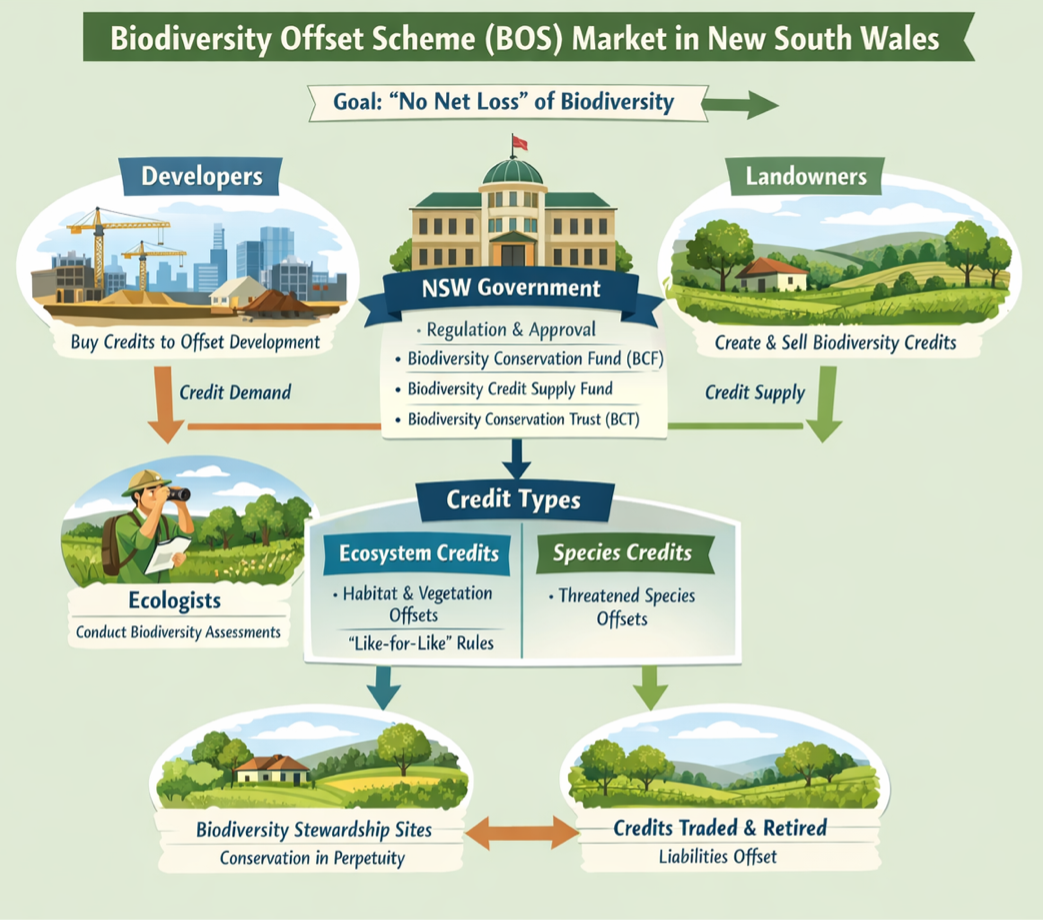
Breakdown of the Biodiversity Offset Scheme (BOS) Market
Credits and Trading Rules
The BOS operates through a credit-based trading system where development impacts are offset by purchasing conservation credits.
Credits are created by landowners who enter into Biodiversity Stewardship Agreements. These agreements commit land to conservation in perpetuity.
Credit liabilities are defined by the biodiversity assessments required for development approvals in NSW. Developers must either create or buy credits to meet these liabilities. Once a credit is used to meet a liability it is retired and can no longer be traded.
There are two types of credits:
ecosystem credits, which enable matching of liabilities and conservation for threatened ecological communities and threatened species habitat. There are currently 1394 Plant Community Type (PCT) credits that trade regionally in 364 offset trading groups in the BOS Scheme.
species credits, which measure the threatened species found at a location. There are currently 249 unique species credits markets.
Strict rules for trading are defined for both ecosystem and species credits, aiming to ensure that trading does not result in a net loss of biodiversity.
Species credits can be traded statewide within a single expected trading range.
Ecosystem credits are more complex and there are many sub-markets depending on where a development or stewardship site is located. Key ecosystem trading rules include that trade is restricted to specific regional boundaries or within 100km. Credits traded must also be within the same offset trading group and have the same threat status or higher (vulnerable, endangered, critically endangered).
These rules and credit types come together to create distinct markets, each with unique prices and dynamics.
Market Participants
NSW Government - Regulates the market, approves developments, provides registers of credits and transfer activities. The Biodiversity Conservation Fund (BCF), Biodiversity Credit Supply Fund (Supply Fund) and Biodiversity Conservation Trust (BCT) all perform dedicated roles.
Developers - Buy credits or pay into the BCF to offset development impacts
Landowners - Generate and sell credits through Biodiversity Stewardship Agreements and manage their land to realise offsetting conservation outcomes.
Ecologists – Conduct biodiversity assessments to determine credit creation in BSAs and credit liabilities for developments
Key Terms
Biodiversity Stewardship Agreement (BSA) - A legal conservation covenant on private land. These agreements generate biodiversity credits to offset development impacts.
Bioregions - NSW is split into defined 18 bioregions and 131 sub-regions by the Interim Biogeographic Regionalisation for Australia (IBRA). Sub-regions in NSW define where ecosystem credits can be traded.
Biobanking Credits - Refers to legacy credits from the Biobanking scheme that preceded the BOS Market. These can also be traded to offset credit liabilities based on an equivalence assessment for each BSA site.
Ecosystem Credits -These credits are created by conserving native vegetation communities on private land.They trade within "Offset Trading Groups" and sub-regions.
Like-for-Like Rules - Trading rules requiring ecosystem offsets to match impact type and location(same/adjacent bioregions).
Species Credits - Measure threatened species that cannot be reliably predicted to occur based on vegetation type alone.
Offset Trading Groups (OTGs) - Groups of similar plant community types that can be traded interchangeably under the like for like rules. 364 groups exist across NSW.
Plant Community Types (PCTs) - Specific native vegetation classifications. PCTs are grouped into OTGs to enable trading.
Drivers of Demand, Supply and Prices in the BOS Market
Like any market, the price for any credits is determined by the balance of supply and demand for that credit market or offset trading group.
Supply reflects the credits existing in the market and available for trade, as well as the availability of private land with the required biodiversity values. Credit creation is slow as each BSA takes considerable time and cost to establish.
Demand is driven by the credit liabilities for approved developments. The initiation of developments that will impact a particular ecosystem, or species, is the fundamental driver of demand.
The most actively traded markets tend to be those ecosystems which occur in areas where there is significant urban or major infrastructure development, as well as a supply of vegetation on private land that can be put into BSAs. If the market is operating properly, prices can be expected to move within a definable trading range. The trading range reflects:
the costs for creating credits for landowners, and
the costs of alternatives to credit purchase for developers - paying into the BCF or undertaking alternative development approaches to reduce credit liabilities.
Each credit has a unique pricing range determined by these factors as illustrated by the Figure below.
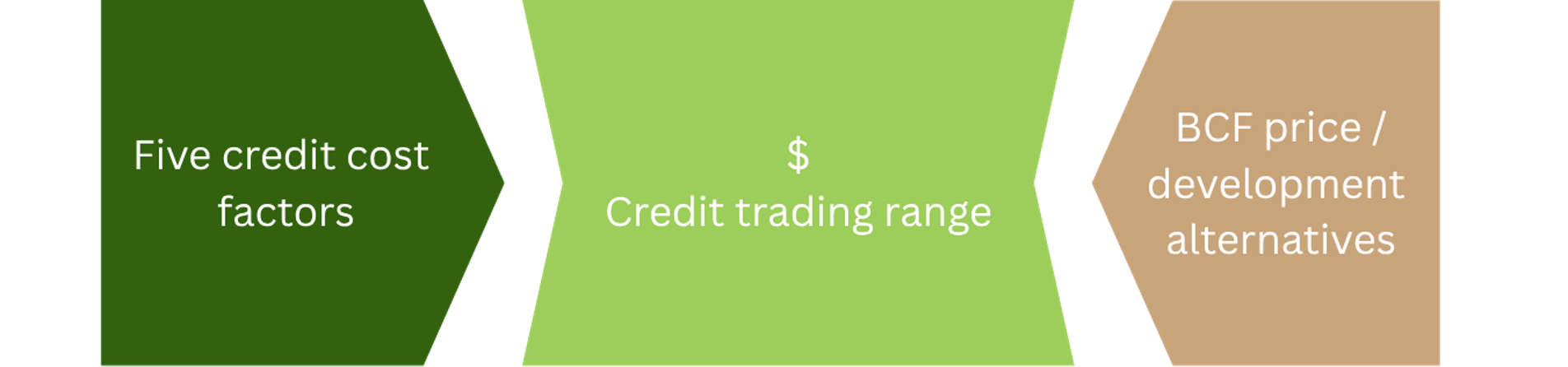
Price drivers for the Biodiversity Offset Market (BOS)
There are five cost factors that should shape the minimum acceptable price for a credit owner:
The cost of the ‘Total Fund Deposit’ that must be paid to the BCT to fund future conservation management of the land (as well as the costs of establishing the agreement).
The estimated reduction (if any) in land value that occurs when land is placed under a permanent BSA that is registered on title.
A risk percentage to provide a financial buffer if management costs exceed the funds put aside for management.
Capital gains tax liabilities that must be met when credits are created.
A profit margin which represents an acceptable return to the landowner for participating in the scheme.
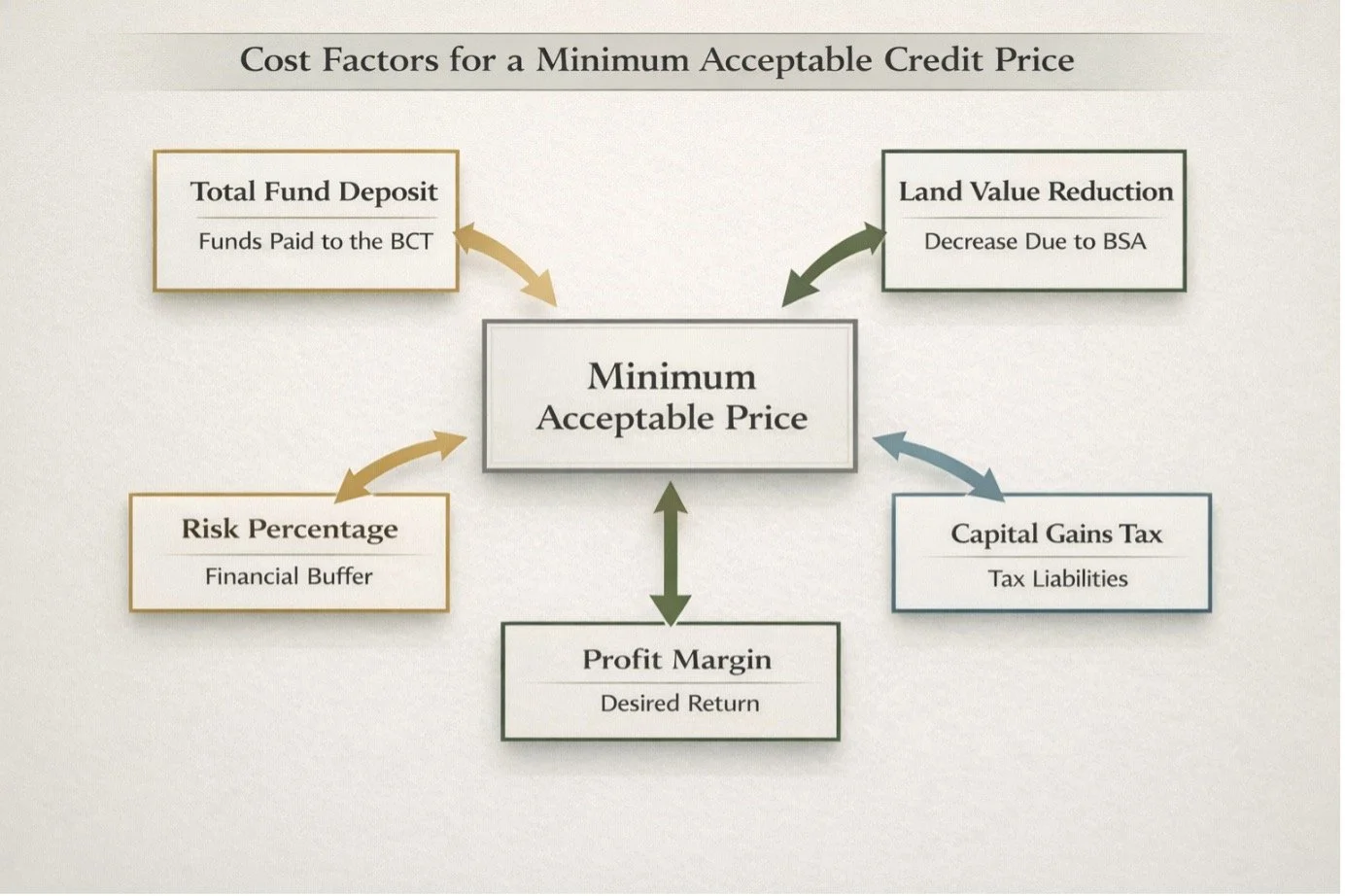
Cost factors of a biodiversity offset credit.
Each BSA and landowner will have a unique set of cost factors that come together to define a lower bound for the economic trading of their credits.
On the other side, the price buyers are willing to pay is effectively capped by the Biodiversity Conservation Fund charge rate. If a developer can choose to pay this cost to meet liabilities, it doesn’t make financial sense to buy credits on the private market unless there is a saving involved, particularly as the time and effort in securing a private sale is often greater than simply making a payment and paying the associated fees
Trading with confidence
Within these upper and lower bounds, actual prices will then be determined by the outcomes of negotiations between buyers and sellers.
Undersupplied credits should trade closer to the upper bound, whilst oversupplied markets will likely trade at a more significant discount.
Many transfers recorded by the NSW Government occur outside of this range. Whilst there is not good information available to understand these transfers, many are likely to be non-market agreements between related parties. Other factors are determining the transfer price in these cases and accurate pricing requires filtering these transfers to ensure any assessment of price reflects genuine trading.
For anyone planning on buying or selling in the BOS market it is essential to understand the credit trading range, recent actual price trends and the balance of supply and demand which will determine prices now and in the future.
Speargrass has reviewed all available market data to understand the current prices for all actively traded credits and the expected price for credit types with limited or no trading history.
Get in touch to discuss the market or request pricing, valuation or trading advice.
