
900,000+ credit demand pipeline
Biodiversity credit demand spans many projects trying to retire credits pre, post and through staged approvals. With demand information not consistently available, it can be difficult to determine the credits the market may need in the future and plan for that.
Speargrass has assessed the pipeline of major projects that were awaiting approval decisions in September 2026.
How demand is created
The NSW Biodiversity Offsets Scheme (BOS) offsets the impacts of development on biodiversity through conservation on other land in NSW. It applies to any development that clears native vegetation above minimum thresholds.
The biodiversity assessment for a development approval defines the proponent's credit liability. The proponent meets it by buying credits, by creating its own credits, or by paying into the Biodiversity Conservation Fund. Once a credit meets a liability it is retired and cannot trade again.
Landholders create credits by entering Biodiversity Stewardship Agreements (BSA), which commit land to conservation in perpetuity. With no significant secondary market, a stewardship site's credits sell only when a proponent needs them.
Demand is credit specific. Species credits trade statewide whereas ecosystem credits trade within Offset Trading Groups with regional boundaries. A Koala obligation can only be met with Koala credits. A grassy woodland obligation on the Riverina can only be met with like credits from the same region.
How Speargrass measured demand
Biodiversity credit obligations are not published in one place. They sit in biodiversity assessment reports for individual projects across planning portals. Speargrass extracted the credit requirements from these reports associated with major projects from the NSW planning portal. The dataset covers all of the 123 unapproved projects that had published potential credit obligations as at 22 September 2026.
Next, we will track determined projects and maintain a register of unmet demand to be updated regularly so market participants can better understand the state of the market.
The figures below are an early signal, not a forecast, the credits have been identified the projects are just yet to be approved. Obligations can change before approval, some projects will not proceed, and local development is not included.
Why demand matters
A credit has value only when a proponent needs to purchase and retire it. Demand determines which credits sell, at what price, and when.
Knowing which credits need to be retired informs BSA feasibility, shows where supply is constrained, and underpins credit pricing decisions by buyers and sellers. The sections below breaks down pre-approval demand.
What the pre-approval data shows
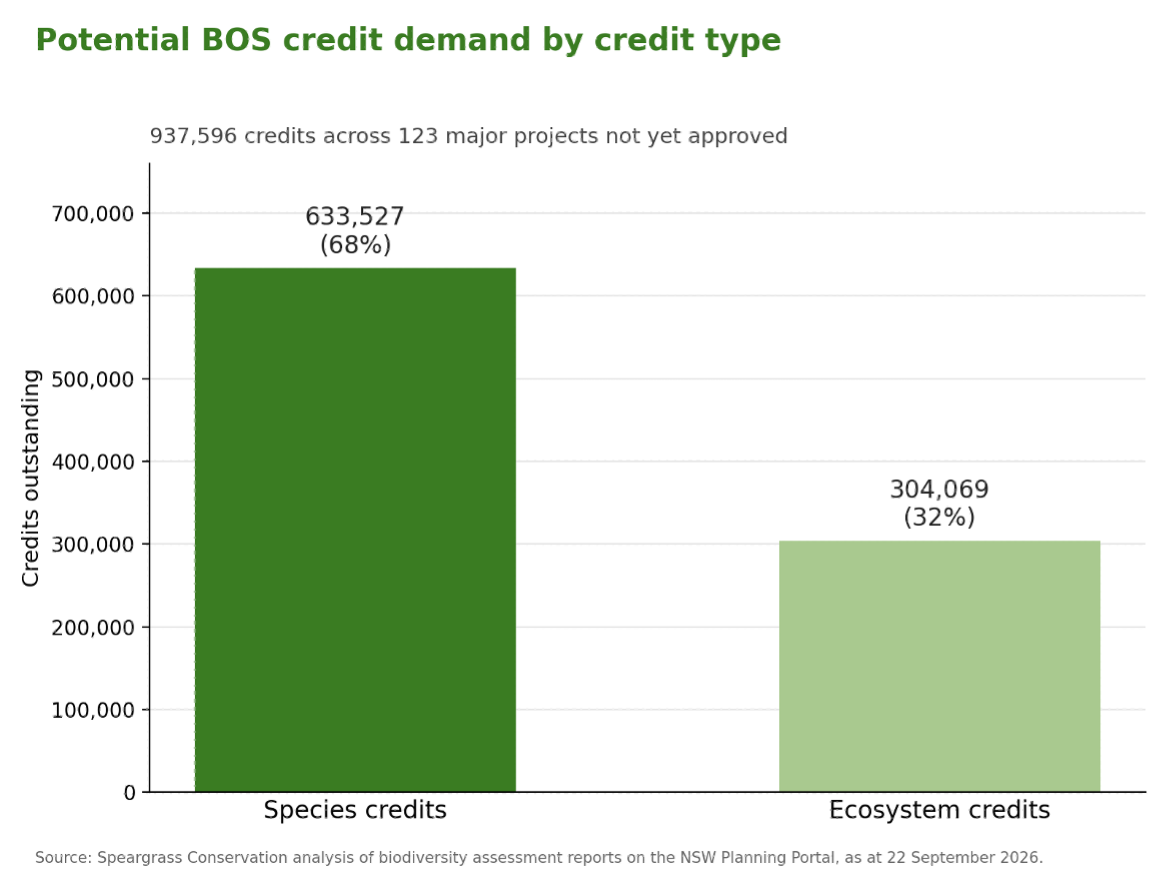
As of September 2026, 123 major projects on the NSW Planning Portal would require 937,596 credits if approved.
Species credits make up 633,527 of those credits, or 68%. Ecosystem credits make up 304,069, or 32%. Species demand spans 131 species markets. Ecosystem demand spans 130 Offset Trading Groups across 13 IBRA regions.
Demand is concentrated
Five projects hold half of all potential demand. Ten projects hold 74%. At the other end, 72% of projects need fewer than 1,000 credits each and together account for 1.5% of the total. The median project needs 95 credits.
Species credits
Species demand comes from 93 of the 123 projects and spreads across 131 species markets. Five species account for 43% of species preapproved demand.
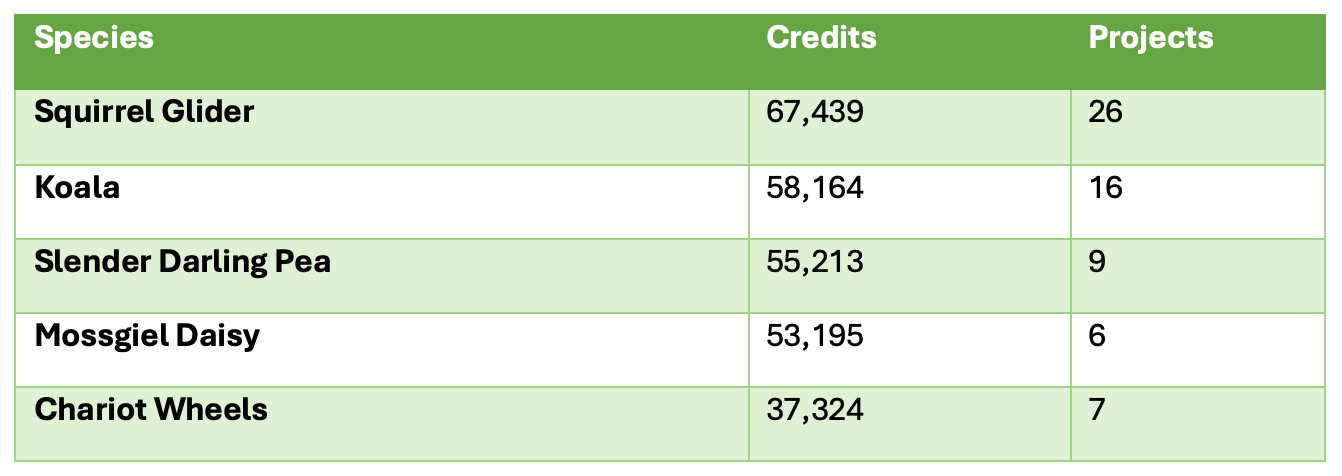
Recurrence and volume only partly align. Squirrel Glider and Koala rank high on both. Southern Myotis appears in 40 projects, more than any other species, but ranks tenth by volume, with 19,001 credits.
Squirrel Glider appears in 26 projects, Large-eared Pied Bat in 18 and Koala in 16.
For over half of all species markets, demand is restricted to a single project, reflecting the limited range of many threatened species.
Ecosystem demand
Ecosystem demand comes from 121 of the 123 projects and spreads across 130 Offset Trading Groups. The average project with ecosystem demand needs 2,513 credits. The median is 53.
Ten projects needing 10,000 ecosystem credits or more hold 74% of ecosystem pre-approved demand. The 68 projects needing fewer than 100 ecosystem credits hold less than 1% of the pipeline's ecosystem credits.
Ecosystem demand is concentrated by location.
The Riverina IBRA region holds 179,586 ecosystem credits, 59% of the total.
One Offset Trading Group, Riverine Chenopod Shrublands (<50% cleared), holds 110,603 credits, or 36% of all ecosystem demand.
Where the demand is coming from
For demand by sector, read Next wave of renewables credit demand.
What it means
Current pre-approval demand is concentrated, so individual project approvals and the progress of project specific procurement strategies will shape demand in each market.
For landholders establishing a stewardship site, understanding local demand is key to securing the Total Fund Deposit for management and recovering establishment costs.
For developers with obligations, understanding competing demand is key to securing supply and negotiating price. In a single-project market, a landholder may not establish a site without a commitment from the proponent. Late purchases can delay construction, and paying into the Biodiversity Conservation Fund is costly for large obligations.
The figures in this piece are a small portion of biodiversity credit demand. Speargrass is building a fuller picture of obligations across the market. If you have a current obligation and would like to discuss it, get in touch.
Method note
Potential demand is drawn from biodiversity assessment reports for major projects on the NSW Planning Portal, as at 22 September 2026. These projects are not yet approved, so the figures are potential obligations, not retirements. No credits have been recorded as met against these obligations, so credits outstanding equal credits required. Ecosystem markets are Offset Trading Groups. Species markets are individual species.
