
Next wave of renewables credit demand
Renewable energy is the largest source of potential demand from yet to be approved developments in the NSW Biodiversity Offsets Scheme. Speargrass reviewed major projects currently seeking approval in the NSW Planning Portal in September 2026. Renewable energy projects will require 500,750 credits if approved, 53% of the 937,596 credits of potential demand.
Demand by sector
Mining and extractive projects hold 301,303 credits across 17 projects. Energy transmission and pipelines hold 128,532 credits from two projects: VNI West and the Narrabri Lateral Pipeline. The remaining 55 projects, across urban development, infrastructure, industry and other sectors, hold 7,011 credits between them.
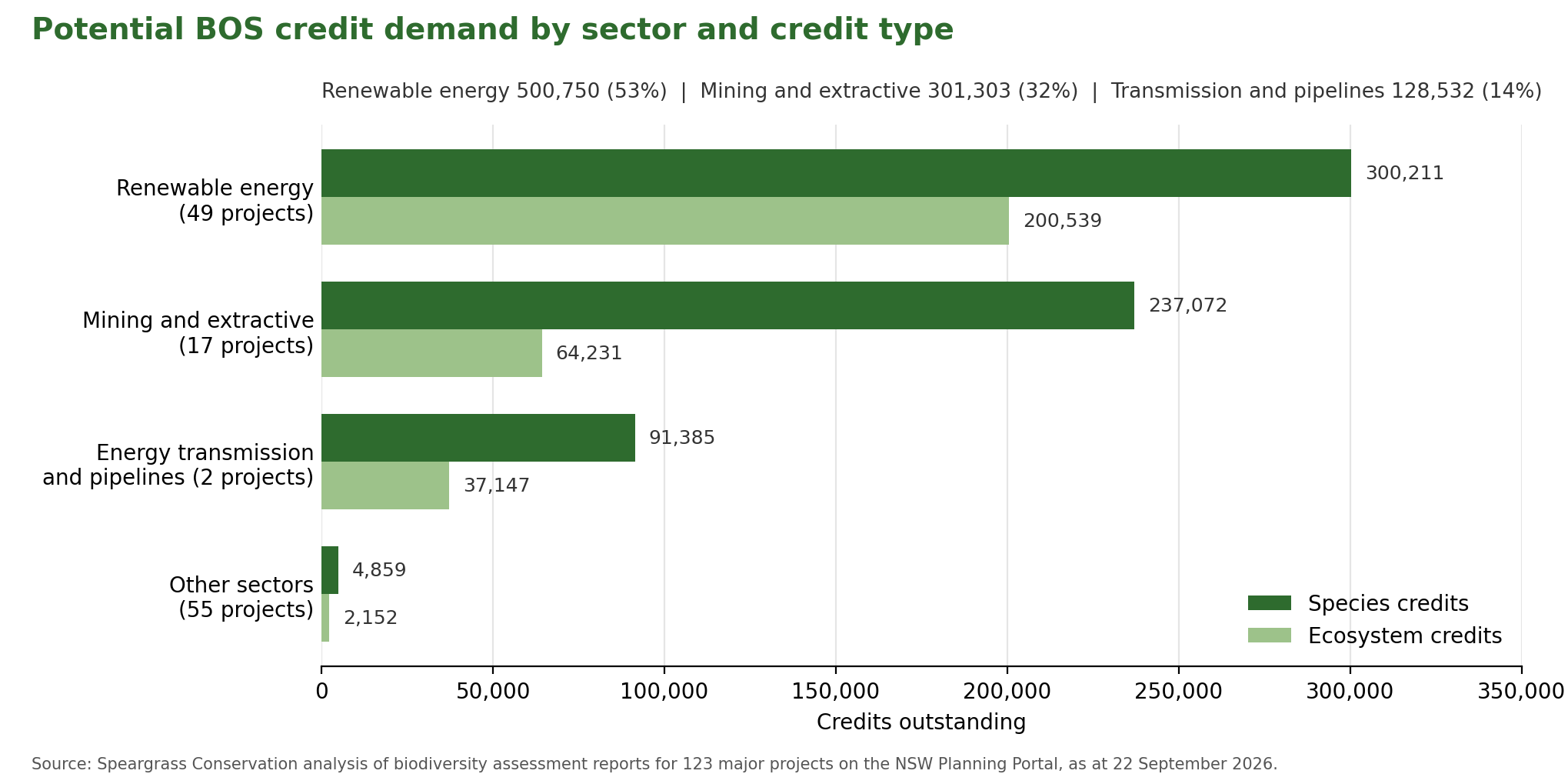
Renewables and VNI West together account for 589,101 credits, nearly two-thirds of all pre-approved demand assessed.
Mining-scale obligations, more projects
Wind carries most of the volume. Fourteen wind farms hold 396,520 credits, and two pumped hydro projects hold most of the rest. Solar and battery projects are more numerous but carry smaller obligations.
Close to 50 renewable projects are in the data, but most of the credits sit with a few of them. Eleven projects each need more than 10,000 credits, and together they hold 93% of renewables credits. Five projects hold two-thirds. The Plains Wind Farm holds 113,000 credits on its own.
That concentration means a few approval decisions set most of the demand.
The big credit drivers may never show up
Many of these projects with major offset credit requirements have been in the potential demand pipeline for years and may not reach final approval. Between March 2021 and March 2026, State significant wind farms in NSW took an average of 1,205 days (3.3 years) to approve, measured from scoping report to determination (Clean Energy Investor Group [CEIG], 2026).
Most wind projects also pass through the Independent Planning Commission (IPC). Four in five wind farm proposals drew more than 50 objections, enough to trigger referral (Cotton et al., 2025). In February 2026 the Planning Minister requested public hearings for Dinawan, Bullawah and Winterbourne wind farms (CEIG, 2026). It is not surprising that proposals with a relatively greater impact on biodiversity attract significant scrutiny and objections, making approval pathways more challenging.
These large, market-driving projects take years to approve and may never reach construction, in which case their credit obligations would not arise.
Big obligations often bypass the market
Under the scheme, proponents can meet a credit obligation by buying credits on the market, by creating their own credits through a Biodiversity Stewardship Agreement, or by paying into the Biodiversity Conservation Fund.
For obligations in the tens or hundreds of thousands of credits, the market may not hold enough of the right credits. Paying into the Fund is the most expensive option. In 2024-25, developers who paid into the Biodiversity Conservation Fund paid an average of $4,670 a credit, against $1,420 for credits purchased in the market (Independent Pricing and Regulatory Tribunal [IPART], 2026). At this scale, that difference can make a project commercially unviable.
Given this, many renewables projects are likely to establish their own Biodiversity Stewardship Agreements alongside project development. That leaves established stewardship sites holding credits with no guaranteed buyer, even in markets where renewables demand is large.
Eligible energy transition projects have a further option. Since May 2025, they can enter a Strategic Offset Delivery Agreement (SODA) with the NSW Government, under which the government delivers the offset on the proponent's behalf. We break down how SODAs work, and what they mean for the market, in SODAs pop: a fourth pathway for satisfying credit obligations gathers pace.
What it means
For current credit holders, renewables demand is not guaranteed demand. Their credits sell only if a project is approved and its proponent chooses to buy from the market.
For landholders considering a stewardship site, the opportunity lies in knowing which projects need their credits. Early conversations with those proponents can turn potential demand into a committed buyer before the site is established.
For proponents, sourcing credits alongside approval shortens the path to construction. Leaving it until after approval can mean paying into the Biodiversity Conservation Fund or waiting for new credits to be created.
Method note
Potential demand is drawn from biodiversity assessment reports for major projects on the NSW Planning Portal, as at 22 September 2026. These projects are not yet approved, so the figures are potential obligations and are subject to change. Sectors are assigned by Speargrass from project names. Approval timeframes, objection rates and Fund and market prices are drawn from the sources listed below.
References
Clean Energy Investor Group. (2026). Delivering major clean energy projects in NSW: 2026 update – Review of NSW statutory planning approvals processes. http://www.ceig.org.au/wp-content/uploads/2026/06/Delivering-Clean-Energy-Projects-in-NSW-2026-Update-Review-of-NSW-Statutory-Planning-Approvals-Processes.pdf
Cotton, R., Colvin, R. M., Loginova, J., & Witt, B. (2025). Renewable energy and regional Australia: The limits to "best practices" for engagement. Energy Research & Social Science, 130, Article 104426. https://doi.org/10.1016/j.erss.2025.104426
Independent Pricing and Regulatory Tribunal. (2026). Biodiversity credits market monitoring: Annual report 2024-25. https://www.ipart.nsw.gov.au/Home/Industries/Other/Reviews/Monitoring-the-NSW-Biodiversity-Credits-Markets
