
SODAs pop: a fourth pathway for satisfying credit obligations gathers pace
A Strategic Offset Delivery Agreement (SODA) enables eligible energy projects to transfer their offset obligation to the NSW Government so projects can progress while the required offset credits are secured.
The first agreements shows how the obligation is delivered, where the credits come from, and what it means for proponents and landholders.
A development under the Biodiversity Offsets Scheme usually meets its offset obligation in one of three ways. The proponent either:
buys and retires credits on the open market,
creates its own credits on a stewardship site, or
pays the Biodiversity Conservation Fund charge and transfers the obligation to the Biodiversity Conservation Trust.
SODAs add a fourth pathway specifically for energy transition projects.
What a SODA is
SODAs were introduced by an amendment to the Biodiversity Conservation Regulation 2017 on 9 May 2025. Three types of project are eligible:
priority transmission infrastructure and Renewable Energy Zone network infrastructure projects under the Electricity Infrastructure Investment Act 2020
renewable energy generation, storage, network or related infrastructure projects within a Renewable Energy Zone
infrastructure covered by a long-term energy service agreement.
A SODA is signed after planning approval, and the department publishes a notice of intention before signing. The proponent pays the NSW Government, and the Environment Agency Head takes on the offset obligation.
The obligation is met by retiring like-for-like credits or by funding conservation actions for the affected species or communities.
Delivery must follow the conservation investment strategy for the region and be completed within three years, unless the Environment Minister approves a longer period.
Progress and expenditure are published each quarter on a public register.
The first two SODAs in the Central-West REZ
The first SODA was signed on 9 September 2025 between the Environment Agency Head and EnergyCo for the Central-West Orana Renewable Energy Zone Transmission Project. The obligation now covers 87,127 credits: 23,903 ecosystem credits and 63,224 species credits.
EnergyCo paid the agreed amounts in three instalments between September 2025 and March 2026. The department can use up to 5% of the total for administration. If credits cost less than the amounts paid, the difference is returned to EnergyCo.
A second SODA for the Mount Piper to Wallerawang Transmission Project was signed in August 2026 and will also be delivered under the Central West Orana Conservation Investment Strategy.
Two more SODAs on the way with notices of intention published for the Hunter Transmission Project, and HumeLink.
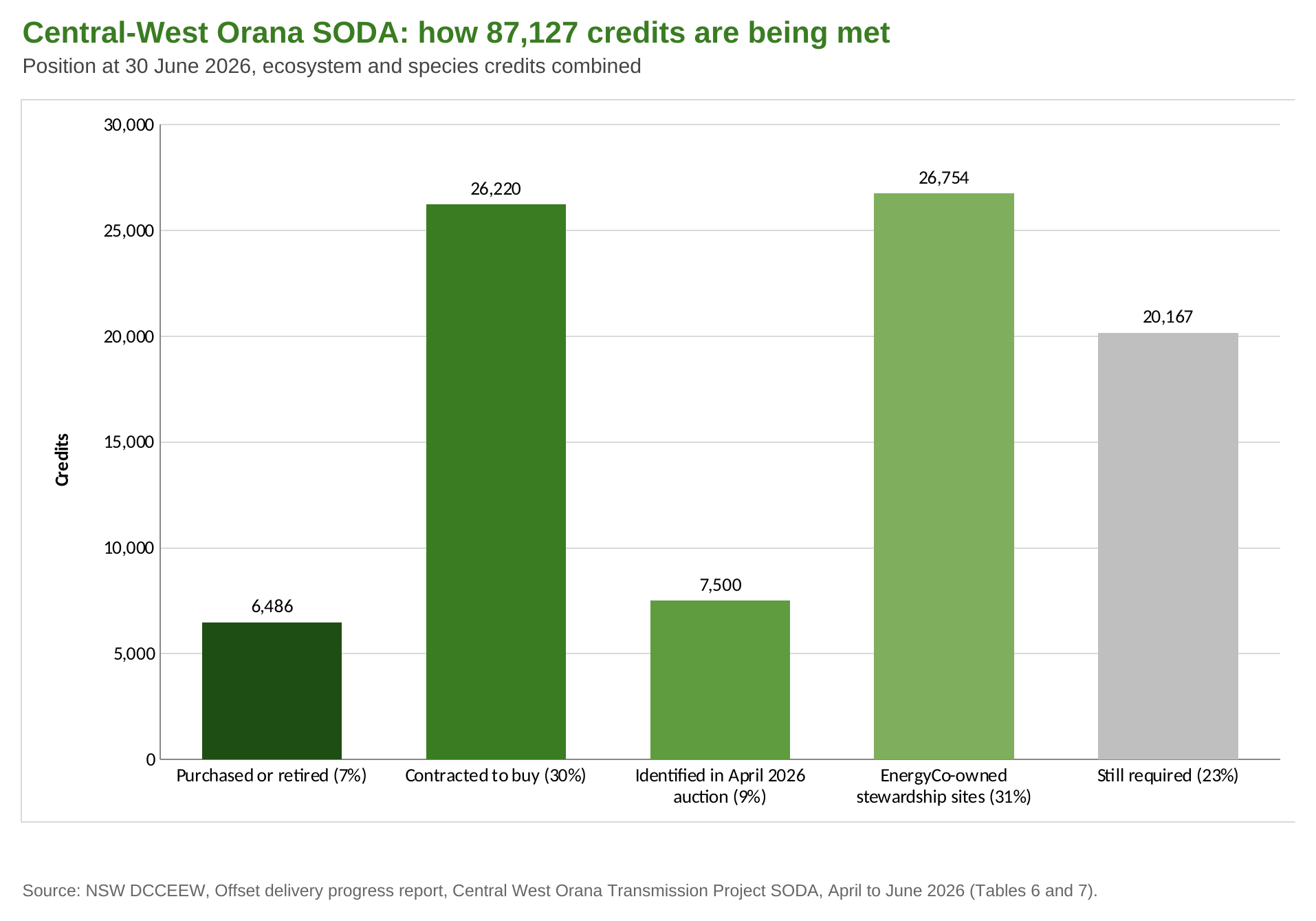
As the figure above shows, progress in securing credits for the first SODA agreement has been significant via purchases and EnergyCo owned stewardship site.
Around 20,200 credits (23%) remain outstanding, and the Department plans at least one more reverse auction before the deadline.
Only one obligation, 140 credits for the endangered river red gum population in the Hunter, is proposed to be met through a restoration project because no credits of that type are available.
On 26 June 2026 the delivery date was extended by 12 months to 30 June 2027.
The extension allows time to finalise contracted stewardship sites, build supply for the remaining credit types and complete assessments of Aboriginal-owned land for credit supply.
Delivery against the regional strategy
Where a SODA sources its offsets depends on location. Each Renewable Energy Zone has a conservation investment strategy, and every SODA in that zone must deliver consistently with it.
Three strategies Conservation Investment Strategies have been published: Central West Orana, Hunter and South West.
The three strategies:
map threatened species habitat, threatened ecological communities, connectivity, ecological condition and under-reserved landscapes to identify priority investment areas
ranks like-for-like credits from stewardship sites inside those priority areas first
favours sites that can generate both ecosystem and species credits
accepts offsets outside the priority areas where they achieve a like-for-like outcome
allows conservation actions for a limited number of species where recovery depends on interventions a stewardship site cannot deliver, and
is reviewed regularly and can change as data and development outcomes change.
The order of preference and the geography differ:
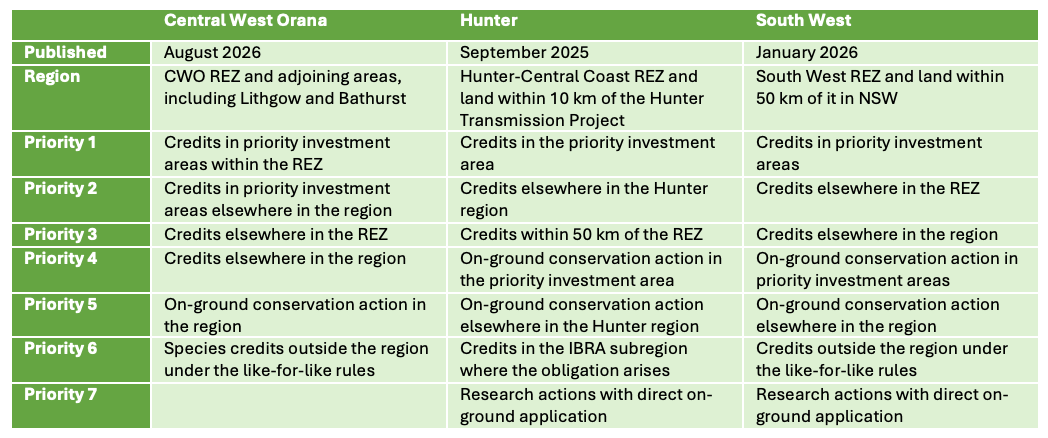
The priorities also reflect each landscape.
Central West Orana weights connectivity most heavily because the region is highly cleared.
The Hunter strategy targets corridors across the valley floor between the large reserves to the north and south.
The South West strategy favours natural regeneration over revegetation in its semi-arid landscapes, with active restoration focused on waterways and floodplains.
Credit sourcing
Credits for a SODA come from two places.
The market. The department buys credits from landholders with biodiversity stewardship agreements through Biodiversity Credits Supply Fund reverse auctions. Offers are selected in the order of preference set by the regional strategy.
The proponent's own sites. The proponent supplies credits from its own stewardship sites. These credits are retired against the obligation without being sold.
In the first SODA, including credits identified in the April 2026 auction, 60% of credits sourced so far come from the market and 40% from the proponent's sites.
The remaining 23% of the obligation is expected to be bought through further auctions.
What it means for the BOS Scheme
SODAs were introduced to "recognise the urgency of the transition to renewable energy" while getting more strategic biodiversity outcomes from offset spending.
Their initial use has accelerated progress to construction for key transmission infrastructure that unlocks generation and storage in Renewable Energy Zones. It remains to be seen whether their use will extend beyond transmission into privately funded generation and storage projects.
More than 20 stewardship sites will supply credits, funding management on over 15,000 hectares of private land.
For proponents, the questions are eligibility and cost. The agreement fixes payments up front, caps administration at 5% and refunds any savings. The other pathways remain available, and a proponent can combine a SODA with its own stewardship sites.
For landholders near a Renewable Energy Zone, a SODA is a defined sales pathway. Credits sell through reverse auctions ranked by the regional strategy's priority areas, so sites inside a priority investment area that can supply the outstanding credit types are best placed to secure sales within the scheme.
Speargrass is monitoring each SODA, the demand, credits supplied and investment areas. If you are considering opportunities to supply a SODA agreement get in touch.
